There’s something oddly satisfying about good drinking water. It doesn’t need to be fancy. It just needs to taste clean, feel fresh, and make you want to reach for the glass again.
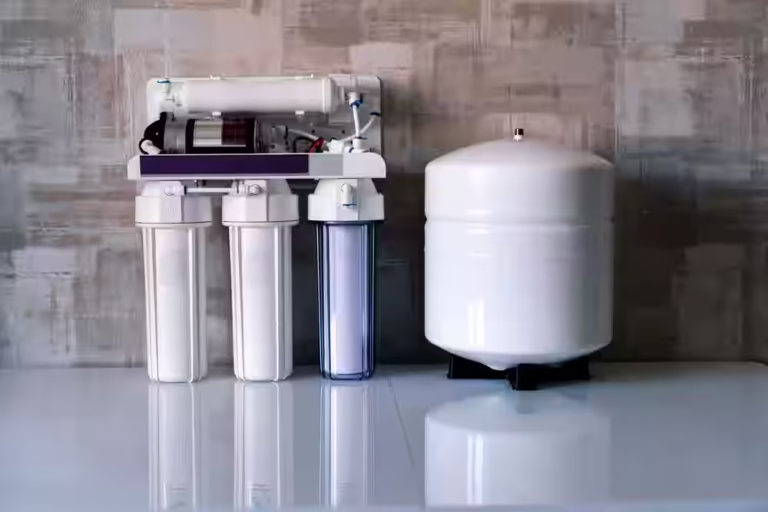
When tap water doesn’t quite deliver that experience, reverse osmosis can be an appealing option. RO systems are designed to reduce many dissolved substances from water by pushing it through a semipermeable membrane. The technology has been around for years, but today’s systems can be configured in ways that make them far more practical for modern households.
Still, choosing an RO system isn’t simply a matter of picking the one with the highest number on the box. Water quality, household demand, membrane capacity, installation requirements, and certification all deserve attention.
A little planning can make a big difference.
Reverse Osmosis Starts With the Water
Before looking at equipment, it’s worth asking why you want reverse osmosis in the first place.
Maybe the tap water has an unpleasant taste. Perhaps testing has identified elevated dissolved solids. You might simply prefer the taste and consistency of treated water for drinking and cooking.
Whatever the reason, understanding the source water helps determine whether RO is appropriate.
A water analysis can provide useful information about total dissolved solids, hardness, pH, and other characteristics. It can also reveal whether pretreatment is necessary.
That’s important because RO membranes aren’t designed to handle every water-quality issue on their own.
If sediment, chlorine, hardness, or other conditions are present at significant levels, pretreatment may help protect the membrane and improve overall system performance.
Customization Can Make a System More Practical
Not every kitchen has the same space, plumbing configuration, or water demand.
Some homes have plenty of room beneath the sink. Others have barely enough space for a trash bin and cleaning supplies.
This is where custom built RO units Champ Series systems can be relevant for households looking for equipment configured around particular requirements rather than relying entirely on a one-size-fits-all arrangement.
Customization can involve membrane selection, storage capacity, filtration stages, controls, or other system components.
The important thing is to focus on the actual need.
A customized system isn’t automatically better simply because it is customized. It should solve a specific installation or performance requirement.
Membrane Capacity Should Match Demand
One of the easiest specifications to misunderstand is membrane capacity.
RO membranes are often described by their production capacity, typically expressed as gallons per day.
But a membrane’s stated capacity isn’t necessarily the same as the amount of water you’ll collect at the kitchen faucet every day.
Actual production can depend on water temperature, pressure, feed-water chemistry, membrane condition, and system design.
That’s why GPD membrane capacities should be viewed as part of the overall system rather than the only number that matters.
A household that uses modest amounts of drinking water may not need an extremely high-capacity membrane. On the other hand, a larger family that cooks frequently and relies heavily on RO water may benefit from greater production capacity.
Correct sizing helps avoid both unnecessary expense and disappointing performance.
Pressure Has a Bigger Role Than You Might Expect
Reverse osmosis relies on pressure to move water through the membrane.
If incoming pressure is too low, production can slow considerably. You may find yourself waiting longer to fill a storage tank or noticing reduced flow at the faucet.
High pressure isn’t automatically better, either. RO equipment has operating limits, and pressure regulation may be necessary.
Before installation, check the home’s water pressure and ask whether a booster pump is needed.
This small detail can make a surprisingly large difference in how an RO system performs.
Certification Gives Consumers Useful Information
Water-treatment equipment can come with a lot of marketing claims.
Terms like “advanced,” “premium,” and “high performance” sound reassuring, but they don’t necessarily tell you how a product has been evaluated.
Independent certification can provide more meaningful information.
For applications where membrane performance and material safety are important, NSF certified membranes can offer an additional level of confidence that the relevant components have been evaluated against applicable standards.
Certification doesn’t mean the system is perfect for every home. It simply gives buyers useful information about how certain components or products have been assessed.
It’s worth asking exactly what is certified and which standard applies rather than assuming the entire system carries the same certification.
Pretreatment Can Protect the Membrane
The RO membrane is the heart of the system, but it shouldn’t have to do everything by itself.
Sediment filters can protect against physical particles. Carbon filtration may reduce chlorine and certain compounds that can damage or affect membrane performance.
If the source water is particularly hard, additional treatment may also be appropriate.
Pretreatment helps create better operating conditions for the membrane and can potentially extend its useful life.
Think of it as preparing the road before sending a valuable vehicle down it.
The membrane still does the heavy lifting, but it performs better when the water entering the system is properly managed.
Storage Tanks Matter in Real Homes
RO systems often produce water more slowly than people consume it.
That’s why many household systems use a storage tank.
The tank allows treated water to accumulate so it’s available when someone wants a glass, fills a cooking pot, or uses the dedicated faucet.
Tank size should reflect household demand and available space.
A larger tank may provide more immediate water availability, but it also takes up more room.
Tankless systems are another option in some applications, but they come with their own design considerations.
Again, there’s no universal winner.
The best configuration depends on how the household actually uses water.
Don’t Forget About Water Waste
Traditional RO systems can send some water to the drain during the filtration process.
The ratio depends on the equipment and operating conditions.
Modern systems can be designed to improve efficiency, but homeowners should still ask about water recovery and wastewater production before making a purchase.
This is particularly important for households that are conscious of water consumption.
An efficient membrane, appropriate pressure, good maintenance, and properly functioning controls can all contribute to better performance.
Efficiency is not one feature. It’s the result of several pieces working together.
Filters Need Attention
An RO system isn’t a “set it and forget it” appliance.
Pre-filters need replacement. Membranes eventually lose performance. Post-filters may also require periodic changes.
The schedule varies according to water quality and usage.
If filters are neglected, the system may produce water more slowly, taste different, or place unnecessary strain on the membrane.
The good news is that routine maintenance is generally straightforward when it’s done on schedule.
Ask the installer what replacement parts cost and how frequently they’re expected to be changed.
That’s part of the real cost of ownership.
Installation Deserves Some Thought
Under-sink RO systems may seem simple, but installation involves more than putting a filter beside the plumbing.
The system needs an appropriate water connection, drainage arrangement, storage location, and dedicated faucet or connection point.
Some homes may require modifications.
The equipment should also remain accessible for filter changes and service.
An installation that looks neat on day one but makes maintenance nearly impossible isn’t really a good installation.
The Best RO System Is the One You Can Live With
Reverse osmosis can be an excellent way to improve drinking water, but the equipment needs to fit the household.
Start with water testing. Understand your goals. Consider membrane capacity, pressure, storage, certification, pretreatment, efficiency, and maintenance.
Then choose a system based on those facts rather than simply buying the most expensive model available.
A well-designed RO system should quietly become part of the kitchen routine. Fill a glass. Make coffee. Cook dinner. Refill the bottle.
No fuss.
That’s ultimately what good water treatment should provide: not more complexity, but better water with less thought required.
When the technology is properly matched to the water and the people using it, the result can be refreshingly simple — a dependable source of water you actually enjoy drinking every day.